
If you are comparing the old vs new tax regime for FY 2026-27, you are probably not looking for theory. You want to know, at your salary level, which option actually leaves more money in your hand after tax.
This guide breaks down the numbers for ₹8 lakh, ₹12 lakh, ₹20 lakh and ₹30 lakh annual income, assuming typical deductions used by salaried people in India, and shows when the old structure wins and when the new one is simpler and cheaper.
Quick Recap: How the Two Regimes Work
Under the old regime, you get a long list of deductions and exemptions. Section 80C, home loan interest, HRA, LTA, health insurance, standard deduction and more can all reduce your taxable income if you claim them correctly.
The new regime cuts out most of these deductions but offers lower tax rates in multiple slabs. It also has a standard deduction now, which makes it much more attractive than in its first version.
So the trade-off is simple: old regime rewards you for planned investments and expenses, while the new one suits people who don’t claim too many deductions anyway.
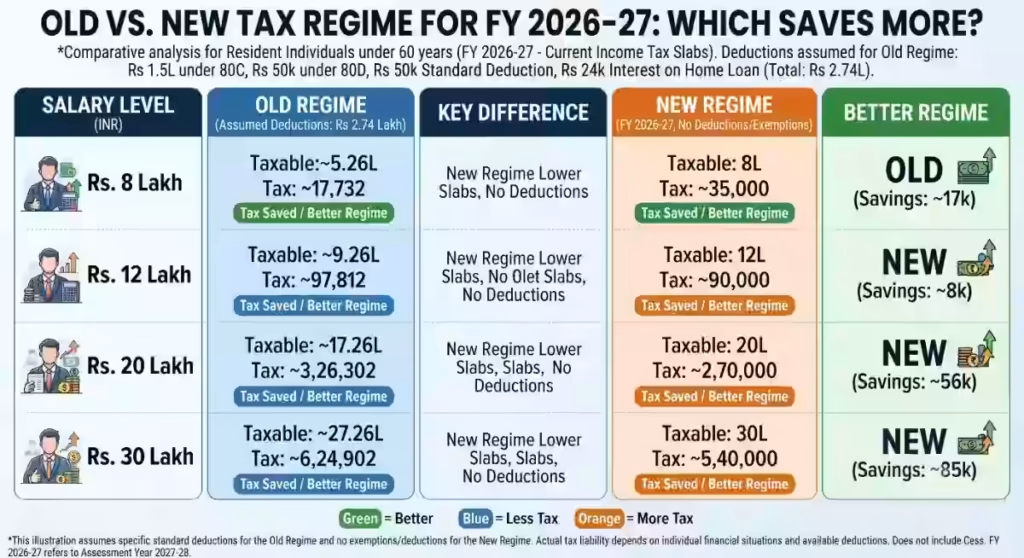
Old Vs New Tax Regime Slabs For FY 2026-27
The government has been nudging salaried individuals towards the updated new regime structure. The slabs are spread out so that tax increases gradually as your income rises instead of jumping sharply at one or two points.
In comparison, the old regime still has fewer slabs with higher rates, but the effective rate can be much lower if you optimise deductions. Those who are confused about which tax regime is better should first list all the exemptions they actually use, not the ones they think they “should” be using.
For most middle-income taxpayers, the key question is: after standard deduction, 80C, HRA and any loan benefits, how much income is actually left to be taxed in the old structure?
Assumptions Used For Salary-Wise Comparison
No two salary structures in India are identical, but you still need a baseline to compare. For this article, we assume a salaried person with basic salary, HRA, some allowances and employer PF contribution, with no complex perquisites.
We also assume commonly used deductions under the old regime: full use of Section 80C limit through EPF and basic investments, health insurance premium for self and parents, and the standard deduction available to salaried individuals.
For the new regime vs old tax regime calculator style comparison, keep in mind that your actual numbers will change if you have a home loan, higher HRA, or lower investments. Use this guide as a direction, then run exact numbers for your own Form 16 and payslips.
Which Regime Saves More Tax At ₹8 Lakh And ₹12 Lakh?
At a salary of ₹8 lakh per year, many salaried employees already hit the full Section 80C limit just through EPF and a basic term insurance or ELSS SIP. On top of that, the standard deduction reduces taxable income even further in the old structure.
Once you factor these in, the taxable figure under the old regime can drop sharply, making the effective tax rate quite low. Under the new system, the rate is lower on paper but you don’t get the same range of deductions, so the total tax may come out similar or slightly higher.
At ₹12 lakh annual income, the story starts to change. If you are disciplined with investments and claim HRA properly, the old system still often wins. But someone living in their own house without a big home loan and who doesn’t invest beyond basic PF may find the new regime beginning to match or beat the old one.
Old Vs New Tax Regime At Middle Incomes
For people in the ₹8–₹12 lakh band, the best approach is to list exact deductions first, then compare total tax under both options. This is the income level where a tax regime comparison for salaried individuals has the highest impact, because one or two deductions can swing the result.
Remember, choosing only by looking at slab charts can mislead you. A small change in HRA exemption or health insurance premium can be enough to tilt the decision from one structure to the other.
Which Regime Wins At ₹20 Lakh And ₹30 Lakh Salary?
As salary moves to ₹20 lakh, most people cannot keep increasing tax-saving investments at the same pace. Deductions like 80C and 80D have limits, so they don’t grow in proportion to income. That’s where the new structure starts becoming more competitive.
Under the old rules, even after using these deductions, the remaining taxable income is still quite high, so the higher slab rates bite harder. Under the new structure, lower rates across multiple slabs mean the effective tax rate can be closer to what you pay in the old system, even without heavy planning.
At ₹30 lakh and above, the gap usually narrows further. If you don’t have a large housing loan interest benefit, the new option may either match or slightly beat the old one in many Indian salary structures, purely because the incremental benefit of deductions has flattened out.
When The Old Regime Still Makes Sense At High Salary
There are exceptions. Someone with a big home loan in metro cities, paying high interest and claiming full HRA exemption, can still get meaningful relief under the old tax structure, even at ₹20 lakh or ₹30 lakh income levels.
In those cases, a simple tax regime comparison salaried people do on a generic chart won’t work. You need to plug in every exemption into a detailed sheet before you decide which option to tick while filing your return.
Practical Way To Decide Your Regime For FY 2026-27
To cut through the confusion, start with your latest payslip and Form 16. List your basic, HRA, special allowance and all other components. Then, write down every deduction you actually claim under the old rules such as 80C, 80D, interest on housing loan and education loan if applicable.
Next, calculate your taxable income under the old system by subtracting all these from your gross salary. Do the same under the new structure, where most of these won’t be available but the rates are lower and simpler.
Many people like using a new tax regime vs old tax regime calculator, but don’t just rely on an online widget. Understand which inputs are changing the output the most, because that’s where you have real control through better investment and expense planning.
Common Mistakes People Make While Choosing
One common mistake is assuming the old structure is always better just because you “do tax saving” every year. In reality, some of that investment may be last-minute and not aligned with your goals, which means you are locking money for small tax gains.
The opposite mistake is choosing the new structure only because it looks simpler. For someone with a modest home loan, decent HRA and planned investments, this can mean giving up real cash savings year after year.
How To Fit Tax Planning Into Your Overall Finances
Tax planning should follow your financial goals, not drive them. Start with basics: emergency fund, insurance, retirement planning and only then look at which deductions you can legitimately claim under the old system.
If you find yourself rushing in March to buy products you don’t fully understand just to reduce tax, that’s a sign your plan is upside down. In such cases, choosing the new structure temporarily while you reset your finances can be a sensible move.
Over time, once your investments are aligned with your goals, you can re-run the numbers for your salary band and see if switching back to the old structure for FY 2026-27 still gives you a meaningful advantage.
Using Reliable Guidance For Your Choice
If tax terms and slab charts put you off, look for explanations that use real-life examples, not just theory. Resources that already break down money-related decisions in simple language, such as lifestyle, banking or investment choices, can be handy for understanding tax decisions too.
For instance, if you enjoy reading practical comparisons on the blog section, use that same habit of questioning features and benefits when you look at tax regimes or investment products promoted in March.
Related Money Decisions That Affect Your Tax
Tax is rarely a stand-alone choice. The way you spend and invest for other goals often ends up deciding which tax framework suits you, especially once your income crosses ₹12 lakh.
Someone focused on building a diversified portfolio through quality assets will naturally make better use of the old structure. On the other hand, people who spend more on lifestyle and personal care may prefer the new one because they don’t want to commit extra cash only to save tax.
If you already follow product reviews and comparison articles on everyday items, such as detailed reviews of personal care products, you know how much clarity a structured breakdown can bring. You can use the same mindset when you compare the two tax frameworks for your own salary.
Conclusion
Choosing between the old vs new tax regime for FY 2026-27 isn’t about which option is “better” in general, but which one suits your actual salary, deductions and goals as a taxpayer in India. Run the numbers for ₹8 lakh, ₹12 lakh, ₹20 lakh or ₹30 lakh using your own payslips and see where the real cash saving lies.
If you like clear, practical money breakdowns, keep following Financial Dost and revisit your tax choice each year so that your take-home pay and long-term planning stay aligned.
Frequently Asked Questions
Q1. How do I decide which tax regime is better for my salary?
Ans: Start by listing every deduction you actually use under the traditional structure: 80C, 80D, HRA, home loan interest and the standard deduction. Then calculate tax under both options using the same income and compare the final payable amount. The regime with the lower total tax for your situation is the better one for that year.
Q2. Can I switch between old and new regime every year?
Ans: For most salaried employees who file their return as individuals without business income, the rules allow you to switch between the two structures while filing each year’s income tax return. That flexibility lets you revisit your choice if your salary jumps, your deductions change, or you repay a home loan and lose that interest benefit.
Q3. Is there any simple new tax regime vs old tax regime calculator I can trust?
Ans: Many tax calculators follow the prevailing slab rates and give a broad idea of which option is cheaper, as long as you enter accurate deductions and exemptions. Use them as a starting point, but always cross-check with your Form 16 and payslips. If the calculator doesn’t let you enter specific items like HRA or loan interest, the result may not reflect your real position.
Q4. How does the choice of regime affect salaried people in India with home loans?
Ans: Home loan interest and HRA relief are often the biggest factors pulling people towards the traditional option. If a large chunk of your EMI is interest and you pay rent in a metro city, the old structure can reduce your taxable income significantly. Those without such benefits frequently find the updated structure simpler and competitive for their take-home pay in India.
Q5. Should I choose the new structure if I do not understand tax planning?
Ans: If you don’t invest regularly, don’t claim many exemptions and prefer a straightforward system, the updated framework can be easier to live with. But treat that as a temporary simplification, not a permanent excuse to ignore investing. As you start planning for financial goals, re-run a tax regime comparison salaried calculation to see if the traditional structure starts saving you more.
Q6. Does my tax regime choice affect how the employer deducts TDS?
Ans: Employers usually ask you to declare your preferred option and expected deductions at the start of the year so that TDS can be computed accordingly. If you change your mind later, TDS may not match the final tax, but the difference will be adjusted when you file your return. Keeping your declaration realistic makes this process smoother and avoids big surprises at filing time.